



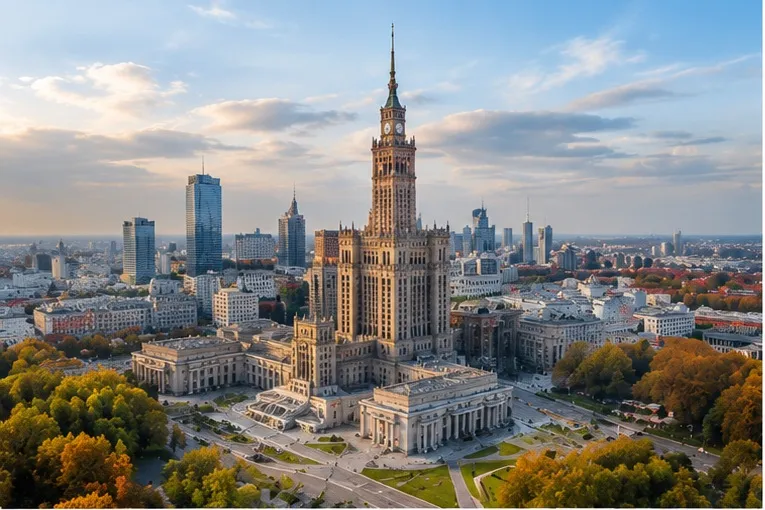
Poland is increasingly relevant to Chinese companies building a European presence
For many Chinese companies, Europe is no longer simply an export destination.
Manufacturers, technology companies, energy businesses and supply-chain operators increasingly need local European operations — whether for manufacturing, warehousing, distribution, sales, service or regulatory reasons.
Poland deserves serious consideration within that strategy.
It combines a large domestic economy, access to the EU Single Market, an established industrial base, significant logistics infrastructure and investment-support mechanisms.
And the Polish economy continues to expand.
According to Statistics Poland, real GDP grew by 3.6% in 2025, following growth of approximately 3% in 2024. In the first quarter of 2026, GDP was another 3.5% higher year-on-year.
But Poland should not be selected simply because its economy is growing.
For an investor, the more important question is:
What strategic role can Poland play in our European operations?
1. Access to the European market
Establishing operations in Poland places a Chinese company inside the European Union and close to some of Europe’s most important markets.
Poland borders Germany, Czechia, Slovakia, Lithuania, Belarus, Ukraine and Russia’s Kaliningrad region, giving it a distinctive position between Western Europe, Central and Eastern Europe and markets further east.
For manufacturing and logistics companies, this can make Poland useful not merely as a domestic market but as a regional operating base.
Germany is particularly important.
Polish-German economic integration is extensive. In the first half of 2025 alone, German exports to Poland reached approximately EUR 49.4 billion, an increase of 5.7% year-on-year.
This illustrates the scale of the industrial and commercial relationship between Poland and Europe’s largest economy.
2. Poland already operates at substantial international trade scale
Poland is not an isolated emerging market.
In 2025, Polish exports of goods reached approximately PLN 1.5535 trillion, while imports reached approximately PLN 1.5797 trillion.
That scale matters.
An investor entering Poland is joining an economy already deeply integrated into European and international supply chains.
For a Chinese company, Poland can therefore fulfil several roles:
manufacturing base → European customers
import hub → China-to-Europe distribution
warehouse → Central European fulfilment
service operation → European customer support
regional subsidiary → EU business development
The optimal structure depends on the business model.
3. China is already a major supplier to the Polish economy
The commercial relationship between China and Poland is substantial, although highly unbalanced.
In 2024, Poland imported approximately EUR 49.2 billion of goods from China, while Polish exports to China amounted to approximately EUR 3.6 billion.
More recent Polish trade data indicate that China’s share of Polish imports increased from 14.5% to 15.5% in 2025.
For Chinese companies, this tells us something important.
There is already a substantial flow of Chinese products into Poland.
The strategic question for some companies therefore becomes:
Should we continue serving Europe entirely from China, or should part of our distribution, assembly, manufacturing, sales or service operation be established locally?
There is no universal answer.
But as European operations grow, the economics of local presence can change.
4. Manufacturing and logistics ecosystem
Poland has developed into an important Central European location for industrial and logistics operations.
PAIH describes the country as increasingly emerging as a strategic hub for manufacturing, logistics and industrial investment in Central and Eastern Europe.
For Chinese manufacturers, this can be particularly relevant in sectors such as:
- automotive and e-mobility,
- batteries and energy storage,
- electronics,
- machinery,
- renewable energy,
- consumer products,
- industrial equipment,
- logistics and distribution.
The value is not simply the availability of industrial buildings.
A successful industrial location requires the intersection of:
real estate + labour + power + logistics + suppliers + incentives + permits.
That is why site selection should be treated as an investment decision rather than simply a property search.
5. Transport infrastructure continues to receive major investment
Poland has continued to invest heavily in transport infrastructure.
In its 2025 economic plan, the Polish government indicated PLN 180 billion for railway modernisation, including infrastructure intended to improve freight transport and support port development.
Road, rail, ports and air cargo all matter differently depending on the investor.
A company importing containers from China may prioritise access to northern seaports.
A supplier serving German automotive plants may prioritise western Poland.
An e-commerce or distribution company may focus on central Poland and access to multiple motorway corridors.
A manufacturer with a high headcount may prioritise labour availability before motorway distance.
There is therefore no single “best city in Poland” for Chinese investors.
6. Labour remains a strength — but Poland should no longer be viewed simply as a low-cost country
This distinction is important.
Poland offers a substantial base of engineers, technicians, manufacturing employees and business professionals.
But labour costs have been rising.
The average monthly gross wage in Poland’s enterprise sector reached PLN 9,228.64 in Q4 2025.
Earlier, in January 2025, the corresponding average was PLN 8,482.47, 9.2% above the previous year.
Therefore, a Chinese company should not build its investment case around the assumption that:
Poland = cheap labour.
A better proposition is:
Poland can offer a competitive combination of workforce capability, industrial infrastructure, location and access to European markets.
For labour-intensive projects, regional workforce analysis is essential before choosing a site.
7. Investment incentives can significantly influence location selection
As discussed in our investment-incentives guide, qualifying new investments can potentially receive corporate income tax support through the Polish Investment Zone.
Depending on location, company size and project parameters, maximum public-aid intensity can reach up to 70% of eligible costs in qualifying circumstances.
Government grants are also available for certain qualifying projects.
For a large Chinese industrial investment, this means two seemingly similar locations may produce materially different financial outcomes.
8. Foreign investors remain active
Poland continues to attract substantial investment projects.
In the first three quarters of 2025 alone, projects supported by PAIH represented approximately EUR 3.12 billion of declared investment value.
By the end of 2025, PAIH described the year as the strongest in its history in terms of investment-support activity.
This does not mean every project should choose Poland.
It does demonstrate that Poland remains actively considered by international investors for significant projects.
9. Poland is not automatically the best choice
A serious market-entry analysis should also acknowledge disadvantages.
Depending on the project, investors may face:
- increasing labour costs,
- competition for skilled employees,
- complex tax and regulatory requirements,
- lengthy procedures for certain permits,
- regional differences in infrastructure,
- limited power availability at some industrial sites,
- language and administrative barriers.
For some projects, Germany, Czechia, Hungary, Slovakia or another European jurisdiction may be more appropriate.
A credible advisor should therefore answer:
Is Poland the right location for this particular project?
rather than simply:
Why is Poland attractive?
10. What should a Chinese company analyze before choosing Poland?
Before committing capital, management should evaluate at least five dimensions:
Market — Where are our customers?
Supply chain — Where are our suppliers and logistics routes?
Operations — What facility, workforce and utilities do we require?
Financials — What are the total operating costs and available incentives?
Execution — How quickly can the project realistically become operational?
Only then should individual locations be shortlisted.